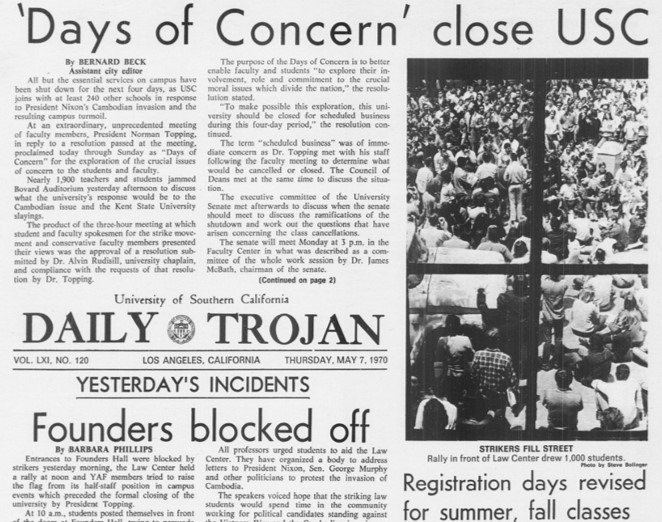
Before most of us arrived on the USC campus, the nation was racked by massive anti-war (Vietnam) protests beginning May 1, 1974.
At Kent State University in Ohio, a demonstration with about 500 students was held on the Commons. On May 2, students burned down the ROTC building at Kent State. On May 4, poorly trained National Guardsmen confronted and killed four students while injuring ten other by bullets during a large protest demonstration at the college. Soon, more than 450 university, college and high school campuses across the country were shut down by student strikes and both violent and non-violent protests that involved more than 4 million students.
While opposition to the Vietnam War had been simmering on American campuses for several years, and the idea of a strike had been introduced by the Moratorium to End the War in Vietnam, which advocated a general strike on the 15th of every month until the war ended, the Kent State shootings seemed to provide the spark for students across the US to adopt the strike tactic. Nationwide, students turned their anger on what was often the nearest military facility—college and university Reserve Officers’ Training Corps (ROTC) offices. All told, 30 ROTC buildings went up in flames or were bombed. There were violent clashes between students and police at 26 schools and National Guard units were mobilized on 21 campuses in 16 states. Walkouts and protests were reported by the National Strike Information Center on at least 883 campuses across the country, with heavy concentrations in New England, the Midwest, and California. Over a million students participated.
USC, with numerous peaceful protests, was not exempt from the Moratorium. The Law School students voted to strike and walked out of their classes. After much negotiation, the USC administration allowed students who desired to protest/strike to miss the remainder of their classes and finals. The university’s president, Norman Topping, said the plan was approved to “recognize the right of conscience of every member of the student body and faculty.” Students not attending classes will be allowed to take a final grade based on completed course work, receive an incomplete and not be charged the usual extra fee to make it up, or substitute an out‐of‐class project with the agreement of the teacher to satisfy course requirements.
Following these events, the 50+ members of the NROTC class of 1974 arrived on campus in September 1970 and were sworn into the United States Naval Reserve.
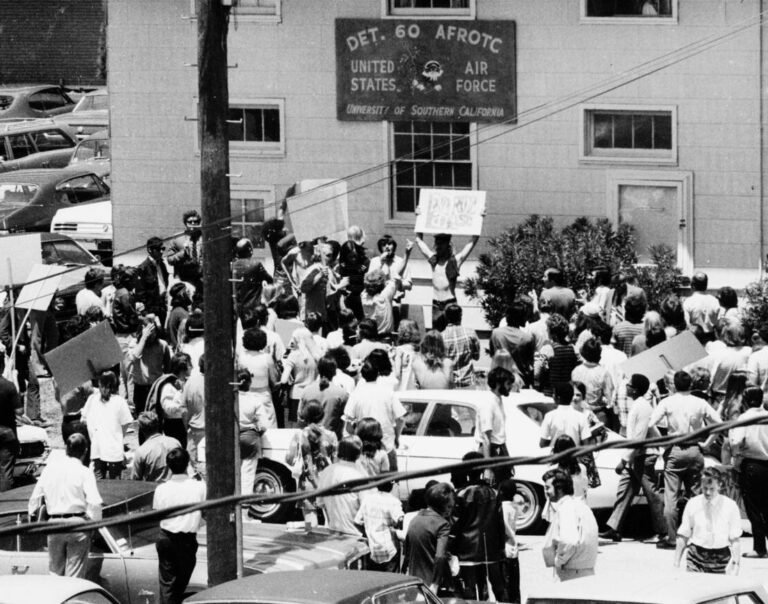
Students attempting to take over AFROTC building at USC in May of 1970 during the Days of Concern. Student demonstrators against the Vietnam war and military training attempted a takeover of the old World War II barracks-type building which accommodated Detachment 60 of the AFROTC. Although students did not get into this building on this occasion, another try was made two years later and demonstrators occupied the second floor of the building for a part of one day. Damage to the building was negligible and there was no violence during either the 1970 or the 1972 events. (Sign being held by student reads: "End ROTC at USC")